
Building Scalable eCommerce Platforms with Cloud Microservices
In today’s rapidly evolving digital landscape, eCommerce platforms are facing unprecedented demands for scalability, resilience, and agility. Traditional monolithic architectures, once the mainstay of online retail, are increasingly struggling to keep pace with the dynamic needs of modern businesses. They often result in slow deployments, limited scalability, and a single point of failure, hindering innovation and impacting customer experience. To overcome these limitations, many organizations are turning to cloud-based microservices architectures, a paradigm shift that promises to revolutionize how eCommerce platforms are built and managed.
Microservices, in essence, are small, independent, and loosely coupled services that work together to form a complete application. Each microservice focuses on a specific business capability, such as product catalog management, order processing, or customer authentication. This modular approach allows teams to develop, deploy, and scale individual services independently, leading to faster development cycles, improved fault isolation, and greater flexibility in technology choices. When deployed on a cloud platform, microservices can leverage the inherent scalability and elasticity of the cloud infrastructure, ensuring that the eCommerce platform can handle peak traffic loads without compromising performance.
This article delves into the intricacies of building scalable eCommerce platforms with cloud microservices. We will explore the benefits of this architectural approach, discuss the key considerations for designing and implementing microservices-based eCommerce systems, and provide practical guidance on leveraging cloud technologies to achieve optimal scalability, resilience, and agility. We’ll also touch upon the challenges involved and offer best practices for navigating the complexities of this transformative approach. Whether you are a seasoned architect or a business leader seeking to modernize your eCommerce infrastructure, this article will provide valuable insights into the power of cloud microservices and their potential to unlock new levels of success in the competitive online marketplace.
Understanding the Benefits of Microservices for eCommerce
Microservices offer a compelling set of advantages over traditional monolithic architectures, particularly for eCommerce platforms that demand high scalability, resilience, and agility. Let’s examine some of the key benefits in detail:
Enhanced Scalability
One of the primary drivers for adopting microservices is the ability to scale individual components independently. Unlike monolithic applications, where scaling requires replicating the entire application stack, microservices allow you to scale only the services that are experiencing high demand. For example, during a flash sale, the product catalog and order processing services might require significant scaling, while other services, such as customer support, may not need to be scaled to the same extent. This granular scalability optimizes resource utilization and reduces infrastructure costs.
Improved Resilience
In a monolithic architecture, a failure in one component can bring down the entire application. Microservices, on the other hand, are designed to be fault-tolerant. If one microservice fails, it does not necessarily impact the functionality of other services. This isolation of failures improves the overall resilience of the eCommerce platform and minimizes downtime. Cloud platforms provide tools and services for monitoring and managing microservices, enabling automatic recovery from failures and ensuring continuous availability.
Faster Development Cycles
The modular nature of microservices enables smaller, independent teams to work on different services concurrently. This parallel development approach accelerates the development process and allows for faster releases of new features and updates. Furthermore, microservices promote code reusability, as common functionalities can be implemented as separate services and shared across multiple applications. This reduces development effort and improves code consistency.
Technology Diversity
Microservices allow teams to choose the best technology stack for each service, based on its specific requirements. For example, one microservice might be written in Java, while another might be written in Python or Node.js. This technology diversity enables teams to leverage the strengths of different technologies and optimize performance for each service. It also avoids vendor lock-in and allows for easier adoption of new technologies in the future.
Easier Deployment and Updates
Deploying and updating microservices is much simpler and faster than deploying monolithic applications. Because each microservice is independent, it can be deployed and updated without affecting other services. This allows for continuous delivery and frequent releases of new features and bug fixes. Cloud platforms provide tools for automating the deployment process, making it even easier to manage microservices.
Designing a Microservices-Based eCommerce Platform
Designing a microservices-based eCommerce platform requires careful planning and consideration of various factors, including domain decomposition, service boundaries, communication patterns, and data management. Here are some key considerations:
Domain-Driven Design (DDD)
DDD is a software development approach that focuses on modeling the domain of the application. In the context of eCommerce, the domain includes areas such as product catalog, order management, customer management, payments, and shipping. DDD helps to identify the different bounded contexts within the domain, which can then be mapped to individual microservices. For instance, the “Product Catalog” bounded context could become a dedicated microservice responsible for managing product information, categories, and inventory.
Defining Service Boundaries
Defining clear service boundaries is crucial for ensuring that microservices are independent and loosely coupled. Each microservice should have a well-defined responsibility and should not be tightly coupled to other services. The Single Responsibility Principle (SRP) is a helpful guideline here: each service should have only one reason to change. Avoid creating “god services” that perform too many functions, as this can lead to increased complexity and reduced scalability.
Communication Patterns
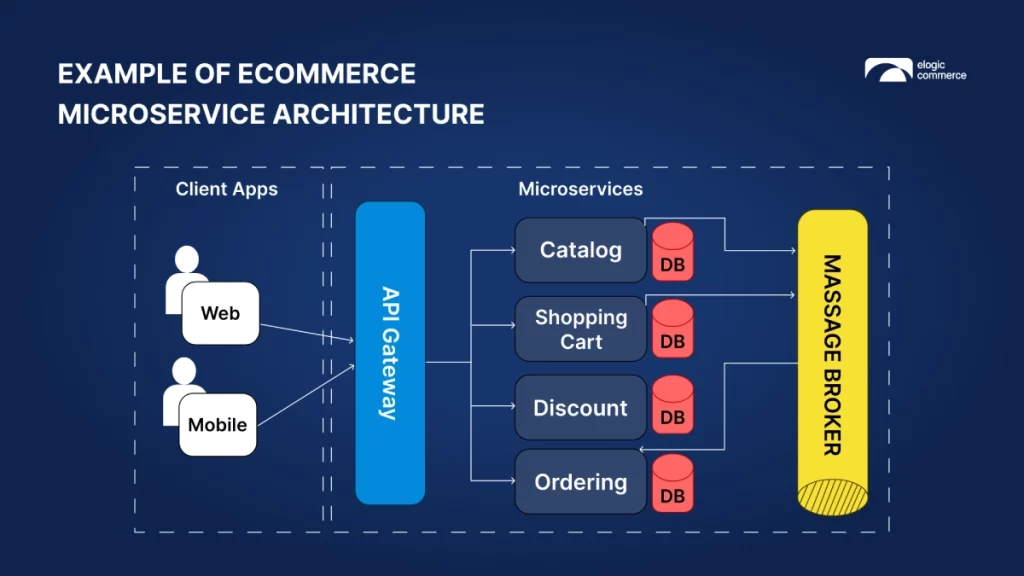
Microservices need to communicate with each other to fulfill user requests. There are two main communication patterns: synchronous and asynchronous. Synchronous communication, typically using REST APIs, involves a direct request-response interaction between services. Asynchronous communication, typically using message queues or event buses, involves sending messages between services without requiring an immediate response. The choice of communication pattern depends on the specific requirements of the application. For example, order processing might use asynchronous communication to ensure that orders are processed even if some services are temporarily unavailable.
Data Management
Microservices typically have their own databases, which allows for greater flexibility and scalability. This approach is known as the “database per service” pattern. Each microservice is responsible for managing its own data and should not directly access the databases of other services. Data consistency can be a challenge in a microservices architecture, especially when dealing with distributed transactions. Techniques such as eventual consistency and Saga patterns can be used to address these challenges.
API Gateway
An API gateway acts as a single entry point for all client requests. It routes requests to the appropriate microservices, performs authentication and authorization, and handles other cross-cutting concerns such as rate limiting and request logging. The API gateway simplifies the client experience by providing a unified interface to the microservices architecture.
Leveraging Cloud Technologies for Scalability and Resilience
Cloud platforms provide a wide range of services and tools that can significantly simplify the development, deployment, and management of microservices-based eCommerce platforms. Here are some key cloud technologies to consider:
Containerization (Docker)
Docker allows you to package microservices and their dependencies into lightweight, portable containers. This ensures that the microservices run consistently across different environments, from development to production. Docker also simplifies the deployment process by providing a standardized way to deploy and manage applications.
Orchestration (Kubernetes)
Kubernetes is a container orchestration platform that automates the deployment, scaling, and management of containerized applications. It provides features such as service discovery, load balancing, and automatic scaling, making it easier to manage large-scale microservices deployments. Kubernetes can also automatically restart failed containers and ensure that the application is always running as desired.
Cloud-Native Databases
Cloud providers offer a variety of managed database services that are designed to be highly scalable, resilient, and easy to manage. These services include relational databases (e.g., Amazon RDS, Azure SQL Database), NoSQL databases (e.g., Amazon DynamoDB, Azure Cosmos DB), and in-memory databases (e.g., Redis, Memcached). Choosing the right database for each microservice is crucial for optimizing performance and scalability.
Message Queues (e.g., RabbitMQ, Kafka)
Message queues are used for asynchronous communication between microservices. They allow services to send messages to each other without requiring an immediate response. This decoupling improves the resilience of the system and allows services to handle peak loads more effectively. Cloud providers offer managed message queue services that simplify the deployment and management of message queues. For more information, you can refer to cloud as an additional resource.
Serverless Computing (e.g., AWS Lambda, Azure Functions)
Serverless computing allows you to run code without managing servers. You simply upload your code to the cloud provider, and the provider automatically scales and manages the infrastructure. Serverless computing can be a cost-effective way to implement certain microservices, especially those that are event-driven or have unpredictable workloads.
Challenges and Best Practices
While microservices offer many benefits, they also introduce new challenges. Here are some common challenges and best practices for addressing them:
Complexity
Microservices architectures can be complex to design, implement, and manage. To mitigate this complexity, it’s important to start with a clear understanding of the domain and to carefully define service boundaries. Use tools and techniques such as DDD, API gateways, and service meshes to simplify the management of microservices.
Distributed Transactions
Managing transactions across multiple microservices can be challenging. Traditional ACID transactions are not well-suited for distributed systems. Techniques such as eventual consistency and Saga patterns can be used to address this challenge. Careful planning and coordination between teams are essential for ensuring data consistency.
Monitoring and Observability
Monitoring and observability are crucial for ensuring the health and performance of a microservices architecture. Implement centralized logging, distributed tracing, and metrics collection to gain visibility into the system. Use monitoring tools to detect and diagnose problems quickly.
Security
Securing a microservices architecture requires careful consideration of authentication, authorization, and network security. Use secure communication protocols (e.g., HTTPS), implement strong authentication and authorization mechanisms, and isolate microservices using network segmentation.
DevOps Culture
Adopting a DevOps culture is essential for successfully implementing microservices. DevOps emphasizes collaboration between development and operations teams, automation of infrastructure and deployment processes, and continuous integration and continuous delivery (CI/CD). A strong DevOps culture enables faster releases, improved quality, and increased agility.
Conclusion
Building scalable eCommerce platforms with cloud microservices is a transformative approach that can unlock new levels of agility, resilience, and performance. By embracing microservices architecture and leveraging the power of cloud technologies, businesses can create eCommerce platforms that are better equipped to meet the demands of the modern digital landscape. While there are challenges to overcome, the benefits of microservices far outweigh the costs for organizations seeking to build truly scalable and resilient online retail experiences. Careful planning, a strong DevOps culture, and a commitment to continuous improvement are essential for success.
Frequently Asked Questions (FAQ) about Building Scalable eCommerce Platforms with Cloud Microservices
What are the key benefits of using a microservices architecture for building a scalable eCommerce platform instead of a monolithic application?
Adopting a microservices architecture for an eCommerce platform offers several advantages over a traditional monolithic approach. Scalability is greatly enhanced as individual services (like product catalog, order management, or payment processing) can be scaled independently based on demand. This prevents the entire platform from being bottlenecked by a single overloaded component. Improved fault isolation is another significant benefit; if one microservice fails, it doesn’t necessarily bring down the entire platform. Faster development cycles are achieved because smaller, independent teams can work on different microservices concurrently. Furthermore, microservices promote technology diversity, allowing teams to choose the best technology stack for each specific service. This contrasts sharply with monolithic applications where a single technology stack often dictates the entire system. This agility translates to faster innovation and quicker response to market changes.
How do I choose the right cloud provider (AWS, Azure, or Google Cloud) and container orchestration platform (Kubernetes, Docker Swarm) for deploying my eCommerce platform’s microservices?
Selecting the ideal cloud provider and container orchestration platform for your eCommerce microservices depends on several factors. Consider your existing infrastructure, technical expertise, and budget. AWS offers a mature ecosystem with a wide range of services, including ECS and EKS (Kubernetes). Azure integrates seamlessly with Microsoft technologies and provides AKS (Azure Kubernetes Service). Google Cloud excels in data analytics and machine learning, offering GKE (Google Kubernetes Engine). When choosing a container orchestration platform, Kubernetes is the industry standard, offering robust features like auto-scaling, self-healing, and rolling deployments. Docker Swarm is simpler to set up and manage but lacks some of Kubernetes’ advanced features. Evaluate your team’s familiarity with each platform, the complexity of your application, and the level of control you require. Don’t forget to factor in pricing models and support options offered by each provider.
What are the essential considerations for designing a resilient and highly available eCommerce platform using cloud-based microservices, particularly regarding data management and inter-service communication?
Building a resilient and highly available eCommerce platform with cloud microservices requires careful consideration of data management and inter-service communication. For data management, consider using a database-per-service pattern where each microservice owns its data. This promotes loose coupling and allows for independent scaling. Implement robust data replication and backup strategies to prevent data loss. For inter-service communication, use asynchronous messaging queues (like RabbitMQ or Kafka) to decouple services and handle failures gracefully. Implement circuit breakers to prevent cascading failures. Employ API gateways for request routing, authentication, and rate limiting. Utilize service discovery mechanisms (like Consul or etcd) to dynamically locate services. Monitor service health and performance metrics continuously and implement automated alerts. Redundancy is key; deploy services across multiple availability zones to mitigate the impact of regional outages. Thorough testing, including chaos engineering, is crucial to identify and address potential weaknesses in the system.


